Your comments
Ah, that explains why I get different behavior depending on where I double-click...
But is it normal to select subword on a bash variable:
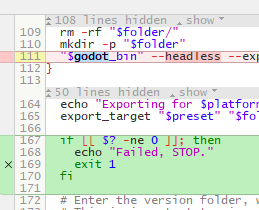
but full word on a bash function call?
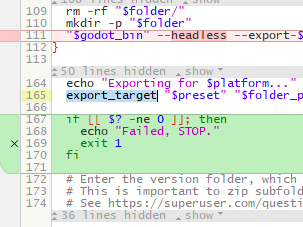
If it can help having a more consistent behavior, I'm fine with a pure text approach where I would have some setting similar to `styledtext.wordCaretMovementType` but for double-click, such as `styledtext.wordDoubleClickSelectionType` that applies everywhere (and the documentation of one parameter would refer to the other so users remember to check both - as I think most users would like to use the same on both)
Not sure why but I'm unable to edit my first post.
Anyway just to update that the setting is now named `styledtext.wordCaretMovementType` and features an enum of choices to mimic various OSes, not `styledtext.useOwnWordBoundaryDetection`which was a more limited boolean.
As a matter of fact, GitKraken also didn't have it... until v11.9.0 released on Feb 3, 2026!
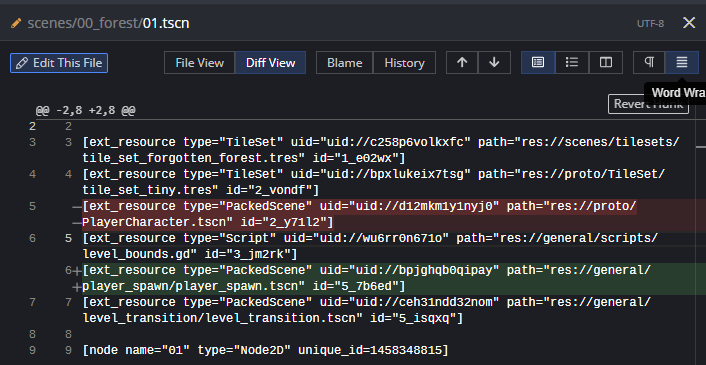
So it's not too late to catch up with the competitors, I guess?
Linux Ubuntu 22.04 with Unity desktop.
I have another PC on Windows 11, I will try it there too.
Sorry, do you mean that:
a. the zoom should always be crisp and it's a bug that it's blurry
b. right-click should already display an option to enable nearest-neighbour scaling and it's a bug that right-click does nothing
c. the hamburger menu should already feature an option to enable nearest-neighbour scaling and it's a bug that it's missing
I can only send a bug report once I know precisely what is missing.
... "system", it's what I said in the post from June 3.
While win, mac and gtk are OK.
But it's not really an issue, I just use gtk now.
Well, it's exactly the same issue as when setting `styledtext.useOwnWordBoundaryDetection = false` before.
If I start here:
|a_b c_d
and I repeatedly press Ctrl+Right, I go there:
a|_b c_d
a_b| c_d
a_b c|_d
a_b c_d|
which is quite slow.
Thanks, 24.1 > styledtext.wordCaretMovementType seems to replace the styledtext.useOwnWordBoundaryDetection entirely but the enum offers more options. "system" is the equivalent of styledtext.useOwnWordBoundaryDetection = true and has the issues I mentioned on Ubuntu, while win, mac and gtk behave as I wanted, one pause per space and skipping underscores.
Finally, word-boundaries also stops once per space but also stops at underscores, like system, but it's good to have a system-independent option for people who reliably want to pause at underscores.
So I'll go with win/mac/gtk, good for 99% of my usage, and I'll be waiting for Subword navigation shortcut feature (link in my previous post).
Note: I'm actually the OP but switched account without noticing at some point.
I opened to new requests:
Specific word boundary settings for hyphen & underscore detection https://smartgit.userecho.com/communities/1/topics/1685-specific-word-boundary-settings-for-hyphen-underscore-detection
Subword navigation shortcuts (e.g. Ctrl+Alt+Left/Right)
https://smartgit.userecho.com/communities/1/topics/1686-subword-navigation-shortcuts-eg-ctrlaltleftright
Customer support service by UserEcho


I would add:
- color conventional commit tags (commit type, scope)
- click on conventional commit tags to filter all commits by that tag (e.g. useful to see all features as opposed to fixes, to see the actual new features done since last release and write a changelog - or all work done on a certain part of the application)
- add buttons to also filter by commit type and/or scope without needing an existing commit to start with
Personally I don't need a full popup to write the conventional commit, but a simple autocompletion in the standard commit message window would suffice (type f expands to "feat" and type beginning of scope name after opening bracket and it will suggest autocomplete and close the bracket and add colon)